
Blog
Kachi Ghani vs Cold Pressed Oil: What’s the Real Difference
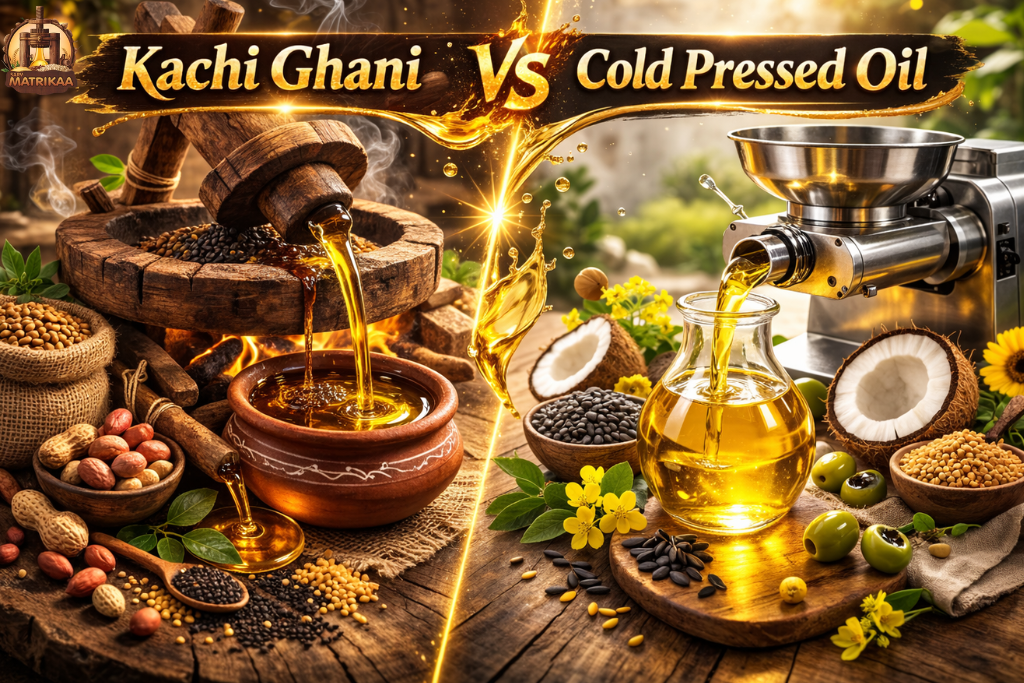
If you go to any grocery store in India today, you will find two kinds of oil kept on the same shelf, sometimes right next to each other. One says “cold pressed.” The other says “kachi ghani.” Both are priced higher than regular refined oil. Both seem to be saying the same thing. So naturally, people assume they are the same product with two different names.
Sometimes that assumption is correct. Often, it is not.
The relationship between kachi ghani and cold-pressed oil is one of those things that seems simple until you look at it closely and once you understand it, you start reading labels very differently. More importantly, you start understanding what you are actually paying for when you choose one over the other.
This blog lays it out clearly. Just a straight answer to a question that genuinely matters for anyone serious about what goes into their food and on their family’s skin.
What Kachi Ghani Actually Means And Where the Term Comes From
Start with the words themselves. Kachi ghani, in Hindi, breaks down simply: kachi means raw or unprocessed, and ghani means oil press. Put together, kachi ghani literally means a raw oil press, a press that extracts oil in its natural, unprocessed state.
The ghani has existed in India for centuries. Traditionally, it was a large wooden contraption, a heavy pestle fitted into a wooden mortar powered by a bullock walking in slow circles around it. The animal’s movement rotated the pestle, which crushed seeds and released their oil gradually, at room temperature, without any external heat source. The process was slow by modern standards. An entire day’s work might yield a modest quantity of oil. But what that oil carried along with it was wonderful, the entire fat content of the seed, its natural vitamins, its aroma, its colour, its every heat-sensitive nutrient that a quicker, hasty process would have destroyed.
This is what kachi ghani means at its core. Not a brand. Not a marketing term. A centuries-old Indian method of extracting oil the way nature intended it to be extracted, slowly, gently, and without interference.
Today, most producers who use the term kachi ghani have replaced the bullock with an electric motor. The wooden press remains. The principle, low temperature, no chemicals, slow pressing, remains. The oil that results is still, in every meaningful sense, kachi ghani oil.
What Is Cold-Pressed Oil: The Modern Definition
Cold-pressed oil is a globally recognised term for any oil extracted mechanically without applying external heat. Throughout the entire process, temperatures stay below roughly 49 degrees Celsius, low enough to keep the oil’s natural composition intact.
The method became widely known through the European olive oil industry before entering Indian markets as a quality benchmark. Health-conscious buyers began understanding something straightforward: heat destroys nutrients. Cold pressing keeps them alive.
In practical terms, cold-pressed oil retains its Vitamin E, essential fatty acids, natural antioxidants, and authentic aroma, everything that makes the original seed nutritionally valuable. The colour is deeper than refined oil. The texture is noticeably thicker. The smell is real and recognisable.
It costs more because the yield is lower; no heat or chemicals are forcing out every last drop.
The equipment used varies. Wooden Kolhu presses, steel expeller presses both qualify. What never changes is the principle: no heat, no chemicals, nothing compromised.
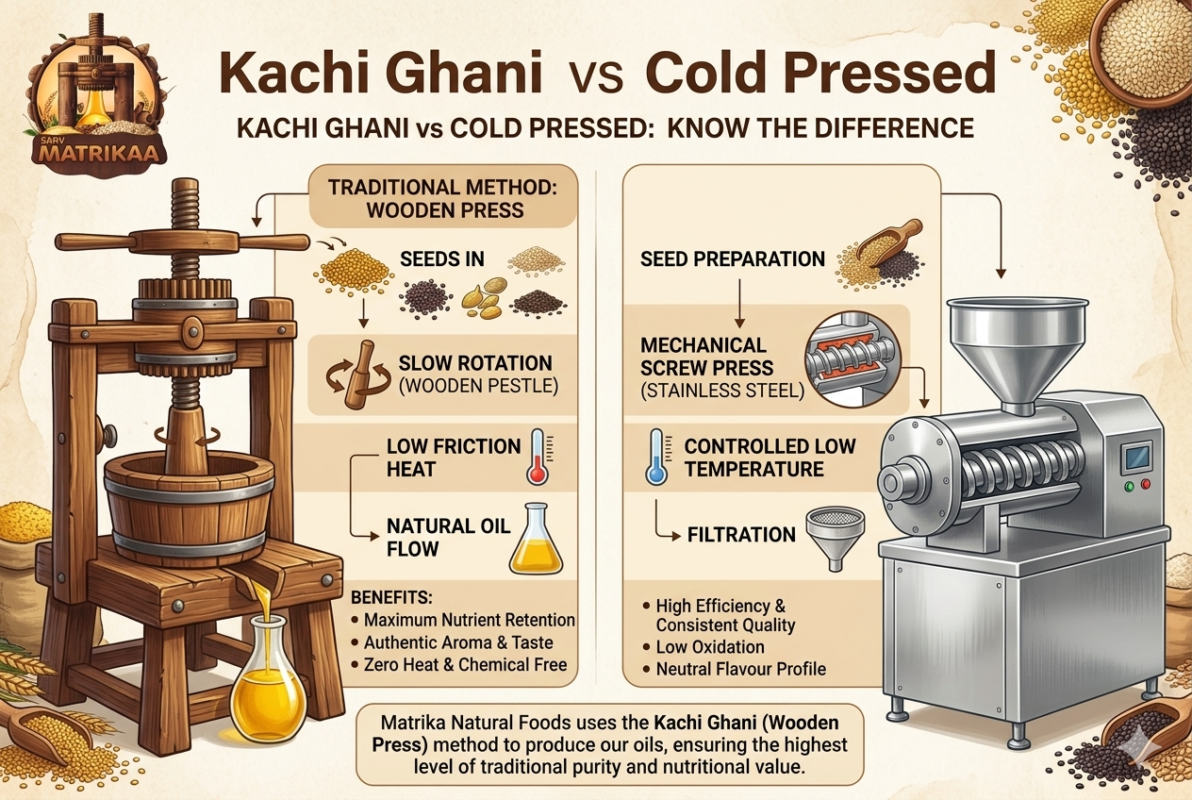
Kachi Ghani vs Cold Pressed: Where They Overlap and Where They Diverge
The answer most people need is this: all kachi ghani oil is cold pressed, but not all cold-pressed oil is kachi ghani.
Kachi ghani is a special technique – the traditional wooden Kolhu method, which is run without chemicals at room temperature. In extraction, the temperatures are seldom more than 30 or 35 degrees Celsius. It is significantly lower than even normal cold pressing thresholds which permit up to about 49 degrees Celsius.
Cold-pressed is the broader term. A modern steel expeller press qualifies as cold-pressed. It runs faster, and temperatures, while still within an acceptable range, sit slightly higher than what a wooden Kolhu produces.
For everyday cooking along with health purposes, the practical difference between the two is small. Both are chemical-free. Both retain natural nutrients. Both are genuinely superior to refined oil.
The distinction only becomes significant when you specifically want the most traditionally produced, lowest-temperature oil available. In that case, genuine kachi ghani from a wooden Kolhu is the more precise answer.
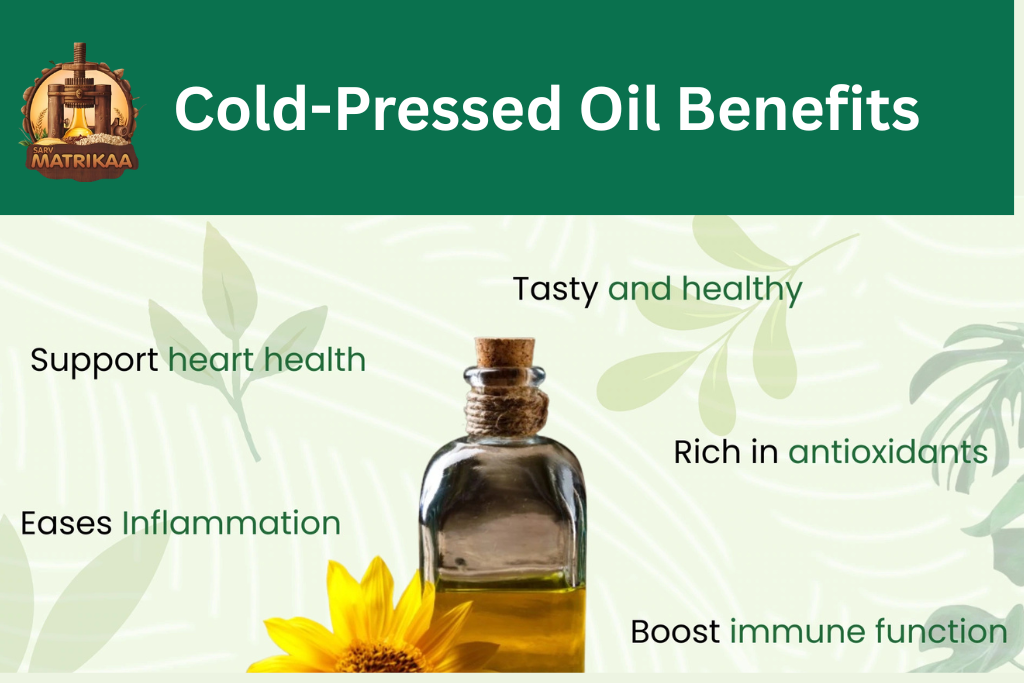
Cold-Pressed Oil Benefits: Why Either Method Beats Refined Every Time
Refined oil is processed at temperatures exceeding 200 degrees Celsius, combined with chemical solvents like hexane. Bleaching removes colour. Deodorising removes smell. What remains is a pale, odourless liquid, consistent, cheap, and nutritionally hollow.
Cold-pressed oil keeps everything the seed originally contained:
- Vitamin E is destroyed above 70 degrees Celsius in refined processing. Cold-pressed oils carry it fully intact, supporting skin health and immune function.
- Essential fatty acids omega-3 and omega-6, are heat-sensitive. Refined processing alters their molecular structure. Cold-pressed preserves them as nature intended.
- Natural antioxidants present in sesame, mustard, and coconut survive only without high heat. These carry genuine anti-inflammatory properties in the body.
- Authentic flavour and aroma cold-pressed mustard oil smells like mustard. Cold-pressed sesame oil carries warm nuttiness. Refined versions smell like nothing, because everything distinctive was processed out.
Beyond nutrition, food cooked in genuine kachi ghani oil tastes categorically different, richer, deeper, and more honest.
How to Tell the Difference When Shopping Reading Labels Without Being Fooled
This is where the knowledge becomes practically useful.
The term “cold pressed” has no strict legal regulation in India at present. Any producer can print it on a label. This creates a real problem for consumers who are paying a premium expecting genuine cold-pressed oil and receiving something considerably less than that.
Here is what to actually check:
- Colour is your first indicator. Genuine cold-pressed oils have a natural, deeper colour. Cold-pressed mustard oil is a rich yellow-green. Cold-pressed coconut oil is slightly off-white or pale yellow. Cold-pressed sesame oil has a warm amber tone. If an oil described as cold-pressed looks pale and clear, question it.
- Smell tells you more than the label does. Real kachi ghani mustard oil has that sharp, characteristic pungency. Real cold-pressed sesame oil smells warmly of sesame. If the oil smells like nothing, something has been done to it.
- Texture and viscosity differ noticeably. Cold-pressed oils are thicker than refined oils. They pour more slowly and feel more substantial.
- Shelf life on genuine cold-pressed oil is shorter, typically six months to a year, stored away from heat and light. If a bottle claims to be cold-pressed but lists a two-year shelf life with no preservatives mentioned, that requires scrutiny.
- Sediment is normal and actually a positive sign in cold-pressed oils. Fine natural sediment at the bottom of the bottle indicates minimal processing.
- The extraction method should be stated explicitly. Words like wooden Kolhu, kachi ghani, wood pressed, or expeller pressed on the label indicate a producer who is being transparent about the process. Vague terms like “natural” or “pure” without specifying the method mean very little.
Why This Matters in an Indian Kitchen Specifically
India has one of the richest oil cultures in the world. Mustard oil in Bengal and Punjab. Coconut oil in Kerala and Tamil Nadu. Sesame oil in Rajasthan. Groundnut oil in Gujarat. These were never random choices; each oil suited the local cuisine, climate, and body according to generations of lived Ayurvedic understanding.
Every one of those oils, in its original form, was kachi ghani. The wooden press was the only technology available, and it happened to be exactly the right one.
Industrialisation changed economics but not biology. Refined oil became cheaper and more available. The local ghani could not compete on price and slowly disappeared. What Indian families lost in that shift was not just flavour, it was the nutritional foundation of their daily cooking.
Returning to kachi ghani and cold-pressed oils today is not a wellness trend. It is simply a correction reclaiming something Indian kitchens had right for centuries, before industrial convenience pushed it aside.
Matrika Natural Foods, Kachi Ghani the Way It Was Always Meant to Be Done
Matrika Natural Foods is a homegrown brand from Ambala, Haryana, built on a single, non-negotiable standard, oil extracted the traditional way, without compromise.
Every oil in their range is produced using the wooden Kolhu method. Room temperature pressing, no chemical solvents, no heat, no shortcuts. The mustard oil, coconut oil, sesame oil, almond oil, and groundnut oil they produce are all 100% pure kachi ghani, retaining their natural vitamins, authentic aroma, intact fatty acids, and real colour. No additives. No preservatives. No blending with refined oil, a practice far more common in the market than most buyers realise.
Sourcing is equally transparent. Matrika works directly with over 60 local farmers, maintaining fair-price relationships that support rural agricultural communities rather than bypassing them.
More than 500 families trust Matrika for daily cooking. Over 5,000 bottles have been delivered across India, growth built entirely on product quality and customer trust, not marketing spend.
Founders Vijeta Sharma and Aman Sharma started this brand with a clear purpose: to bring Indian families the same quality of oil their grandparents cooked with. Traditionally pressed, honestly sourced, purely made.
For anyone who takes seriously what goes into their daily cooking, Matrika Natural Foods is a straightforward and trustworthy place to start.
Contact Matrika Natural Foods
+91 9638812283
Shop No-824/7, Ground Floor, Jalbera Road, Ambala City, Haryana – 134003