
Baby Massage Oil Guide: Best natural Oils for Newborn
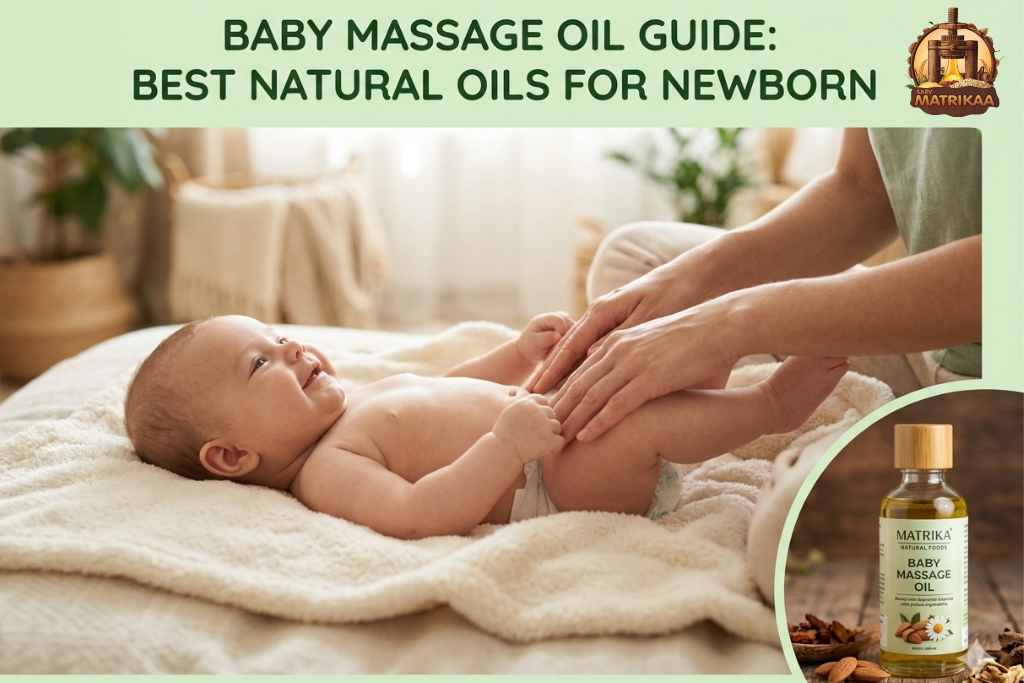
The moment a baby arrives, so does the advice. From every corner of the family, someone is suggesting an baby massage oil, swearing by a brand, or warning you against something their neighbour used. It is overwhelming. And somewhere inside all of that noise is a genuinely important decision because what you apply to a newborn’s skin every single day is not trivial.
Indian families have been massaging babies with oil for thousands of years. That part is not the problem. The problem is that somewhere along the way, the market is filled with products that look like oils, smell like something pleasant, and do almost nothing useful. Mineral oil dressed up in a nice bottle. Chemical blends with calming labels. Refined, stripped-down liquids are sold at a premium because the packaging says “gentle” and “baby safe.”
This guide is for parents who want to actually understand what they are buying, not just follow a label.
Your Newborn’s Skin Absorbs Everything: That Is Not a Warning, It Is a Fact
Nobody talks about this plainly enough, so here it is: a newborn’s skin is not a barrier the way adult skin is. It is thin, highly permeable, and absorbs substances readily into the bloodstream. This is simply how infant skin works and it has a direct bearing on what you choose to apply on it daily.
Mineral oil, which forms the base of most budget baby oils across India, is a petroleum derivative. Inexpensive, colourless, stable on the shelf. It coats the skin and creates a temporary softness but it nourishes nothing. There are no vitamins in it. No fatty acids. No antioxidants. Just an occlusive layer that sits on the surface and sometimes blocks pores over extended use.
Natural plant-based oils behave entirely differently. Almond oil is genuinely rich in Vitamin E. Sesame oil contains calcium, zinc, and copper nutrients that actively support bone development in growing infants. Cold pressed coconut oil carries lauric acid, which has documented antimicrobial properties. These are not marketing points. These are the actual compositions of these oils when they are extracted correctly and not refined into nutritional emptiness.
The oil you massage into your baby’s skin every morning is, in a real sense, feeding the skin. That reframing alone should change how you shop for it.

Coconut, Almond, Sesame, Mustard: Each One Has a Specific Purpose
No single oil works for every baby in every season; each one serves a distinct purpose.
- Coconut oil is an ingredient in South Indian families that is centuries old. It is lightweight, absorbs quickly and is also inherently antimicrobial. Always use cold-pressed, refined coconut oil, which loses most of its good compounds in the process.
- Almond oil is most tolerant of all skin types. It becomes slowly absorbed, it is not heavy, it is well adapted to dry and sensitive skin, and the fact that it contains Vitamin E and Vitamin D makes it very nutritious. A safe option for the very small babies.
- Sesame oil is the traditional winter oil of North India. Warming by nature, nutrient-dense, and rich in zinc, calcium, and natural antioxidants. Use only cold-pressed, unroasted white sesame: not the dark cooking variety.
- Mustard oil is effective in cold months and improves circulation. Introduce it from the second or third month, not from birth. Always wood pressed, never refined.
Summer Changes Everything: Here Is What Actually Works in Indian Heat
This question comes up constantly among Indian parents, and the answer matters because getting it wrong directly affects the baby’s comfort.
India’s summer is not moderate. March through June across most of the country means sustained heat, high humidity in coastal regions, and dry heat in others. Applying a warming, heavy oil on a baby during this period traps heat against the skin, contributes to blocked pores, and is a straightforward cause of prickly heat rashes.
For baby massage oil in summer, the rule is simply this: go light, go cooling.
- Cold-pressed coconut oil is the most practical summer option. Naturally cooling in character, it absorbs quickly, does not sit heavy, and handles humidity well. It keeps the baby’s skin soft without the heat-trapping effect of heavier oils.
- Cold-pressed almond oil performs equally well in summer. Fast-absorbing, non-greasy, and comfortable on the skin even when the air around the baby is already warm.
Set sesame oil and mustard oil aside from approximately March to October. The warming properties that make them wonderful in December make them genuinely counterproductive in May.
One practical point on timing: in summer, massage your baby between 7 and 9 in the morning. Keep the session to ten minutes. Give a gentle lukewarm bath immediately afterwards to clear the oil from the skin before the day heats up.
Cold Pressed, Wood Pressed, Kacchi Ghani: What These Terms Mean and Why They Matter
Two bottles of almond oil sit side by side on a supermarket shelf. One costs 80 rupees, the other 350. Both carry the same label. The difference is entirely in how they were made.
Refined oils are processed at high temperatures using chemical solvents. The method is efficient and cheap, but heat and chemicals destroy the very things that make plant oils worth using: Vitamin E, omega fatty acids, antioxidants, and natural aroma. What remains is technically oil. Nutritionally, it is a hollow version of the real thing.
Cold-pressed oils, extracted slowly at room temperature using the traditional wooden Kolhu, known across India as kacchi ghani, retain everything. Deeper colour, authentic smell, thicker texture, full nutritional composition. Nothing cooked out, nothing chemically stripped.
For a daily newborn massage oil, this gap is not minor. It accumulates over weeks and months of use.
Before buying, check the label for: cold pressed, wood pressed, kacchi ghani, or unrefined. If none of those terms appears, the oil has been refined.

The Massage Itself: Done Right, It Takes 15 Minutes and Does a Great Deal
- Time it properly. Not right after feeding: wait at least 45 minutes. Not when the baby is hungry or drowsy either. Awake, calm, and settled is the window you want.
- Warm the oil first. Bottle in a bowl of warm water, five to seven minutes. Test on your inner wrist before applying. It should feel warm, not hot. Never heat oil directly over a flame.
- Start with the legs. Almost all newborns are more comfortable with touch on the lower limbs first. Long, smooth strokes from the thighs down to the feet. Repeat a few times before moving elsewhere.
- Chest, arms, abdomen. Gentle strokes on the chest, down the arms to the hands. On the abdomen, move in a clockwise direction that follows the natural path of digestion and helps with gas. No heavy pressure anywhere.
- Turn the baby for the back. Face down, only when awake, only with you right there. Long strokes along the muscles on either side of the spine, not on the spine itself.
- Ten to fifteen minutes is enough, particularly for newborns in the first two months. Infant nervous systems are still developing, and a long session can overstimulate more than it helps.
- Talk to the baby throughout. This is the part people underestimate. The physical massage and the human connection are not separate benefits; they work together. The baby is learning your voice, your touch, your presence. Let the session be warm rather than clinical.
Follow with a gentle lukewarm bath.
What to Put Back on the Shelf Immediately
This is not complicated, but it is worth being direct about:
- Mineral oil is in a significant majority of budget baby oils sold in India. It is a petroleum derivative. It does not nourish. Put it back.
- Artificial fragrance listed as “fragrance,” “parfum,” or “perfume” on the ingredient list is one of the most common causes of contact dermatitis and skin sensitisation in young infants. If you see it, walk away.
- Parabens methylparaben, propylparaben, and related compounds are chemical preservatives that absorb through infant skin. The research on their hormonal effects is not conclusive, but for a daily-use product on a newborn, the precautionary logic is straightforward.
- Vague ingredient lists with terms like “natural oils blend” or “vegetable oil” without specifying what oil as well as how it was extracted, should raise immediate questions. Transparency on a label reflects transparency in production.
A genuinely pure baby massage oil has one ingredient. Maybe two. The label is short. The extraction method is stated. If you are reading a paragraph of ingredients, you are looking at a formulated product, not a pure oil.
Always patch test before fully using the inner forearm for 24 hours, watch for redness or irritation.
Matrika Natural Foods: This Is What Honest Oil Actually Looks Like
Every standard described in this guide: cold-pressed extraction, zero chemicals, full nutrient retention, transparent sourcing, is what Matrika Natural Foods was specifically built around.
Matrika is based in Ambala, Haryana. A genuinely homegrown Indian brand. They press their oils using the traditional wooden Kolhu method at room temperature, no heat, no solvents, no shortcuts. The seed goes in, the oil comes out, it goes into the bottle. That is the entire process. Nothing added, nothing stripped away.
Their cold-pressed coconut, almond, sesame, and mustard oils are appropriate for newborn skin from the very first days. Because nothing in the extraction compromises the oil’s natural composition, every bottle contains the actual vitamins, fatty acids, and antioxidants that the seed or nut carries. Not a refined approximation of it.
What also stands out about Matrika is what sits behind the product. They work directly with over 60 local farmers, paying fair prices along with building stable relationships with the agricultural communities that grow their raw materials. Over 500 families across India use Matrika regularly. More than 5,000 bottles have been delivered nationwide. That growth came from one thing: people who tried the oil, and trusted it, as well as came back.
The founder’s belief is stated plainly: purity is the priority. Not a compelling tagline on a bottle. An actual operating principle reflected in every decision the brand makes, from sourcing to pressing to packaging.
For parents who want to apply oil on their newborn’s skin every morning and feel completely certain about what it contains and how it was made, Matrika Natural Foods is the honest answer.
Get in touch with Matrika Natural Foods:
+91 9638812283
Shop No-824/7, Ground Floor, Jalbera Road, Ambala City, Haryana – 134003
Frequently Asked Questions (FAQs)
1. Which is the best baby massage oil in India for newborns?
The best baby massage oil in India is usually a cold-pressed natural oil such as coconut oil, almond oil, or sesame oil. These oils contain natural vitamins, fatty acids, and antioxidants that nourish a newborn’s delicate skin.
2. Is coconut oil safe for newborn baby massage?
Yes, cold-pressed coconut oil is one of the safest options for newborn baby massage. It is lightweight, absorbs quickly into the skin, and contains lauric acid with natural antimicrobial properties.
3. Which baby massage oil is best in summer in India?
For baby massage oil in summer, lighter oils work best. Cold-pressed coconut oil and almond oil are ideal because they absorb quickly and do not trap heat on the baby’s skin.
4. Can almond oil be used for a newborn baby’s massage?
Yes, almond oil for baby massage is widely recommended for newborns. It is rich in Vitamin E and healthy fatty acids, making it gentle for sensitive skin. Always choose pure, cold-pressed almond oil and perform a patch test before full use.
5. How often should you massage a newborn baby with oil?
Most parents massage their baby once daily, usually before a bath. A gentle massage using a natural newborn massage oil for about 10–15 minutes helps improve circulation, supports skin health, and strengthens the parent-baby bond.