
Almond Oil for Skin: Key Uses, Care Tips & Daily Benefits

There are some things that never really leave an Indian home. Steel tiffins, old handwritten recipes, and, almost always, a bottle of almond oil sitting quietly in a corner. It may change shelves or move from the mother’s room to the children’s cupboard over the years, but it never disappears. Almond oil has that quiet, dependable place in the household—not as a “beauty product,” but as a thing we reach for without thinking too much.
Growing up, most of us didn’t question it. If the winter air started biting at our cheeks, someone would say, “Put some almond oil.” If the skin looked dull before a family function, again, “Put some almond oil at night, you’ll look fresh in the morning.” And, without fail, it worked in its own steady way.
At Matrika Natural Foods, almond oil isn’t just one more product in the line-up. It represents a certain way of living, one that values purity and patience. When we decided to produce oils through the wooden Kolhu method, the choice wasn’t made for business—it was made for honesty. A wooden Kolhu doesn’t hurry. It doesn’t heat seeds to squeeze the last drop. It simply turns, slowly, letting the almond offer what it naturally holds.
A lot of people today don’t really know the difference between regular almond oil and wood-pressed almond oil. The difference is actually easy to feel. Regular oils—especially refined ones—often feel thin, like they were stretched. Wood-pressed almond oil feels fuller. A bit heavier. The aroma is mild but real; nothing perfumed. When you put a drop between your fingers, it spreads slowly, almost thoughtfully, the way natural fats do.
This is why so many families who shift to traditionally pressed oils don’t go back.
Almond Oil and the Skin: What It Really Does
People often talk about “almond oil benefits for skin,” but the truth is almond oil doesn’t act like a miracle cream. It behaves more like food—food that the skin understands. When you use it consistently, the changes are subtle but steady.
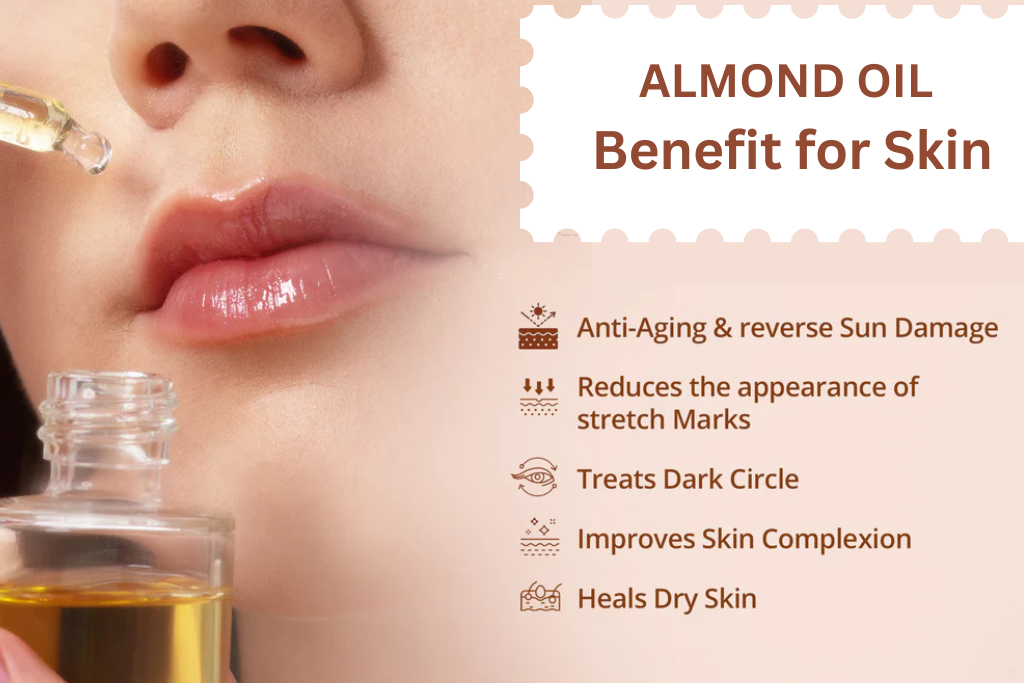
1. Almond Oil for Skin that truly moisturises
Not the quick moisture that disappears in an hour. Almond oil settles in and stays. It softens the skin’s surface but also supports the layers beneath. When the oil is pure—like the cold pressed almond oil for skin, the skin seems to absorb it better because nothing artificial gets in the way.
2. It improves skin tone gradually
If you look at a person who has used almond oil for years, their skin usually looks even, not patchy. Vitamin E plays a role here. But the bigger difference comes from oils that haven’t been exposed to heat. Heat destroys the delicate compounds that help repair the skin. That’s one reason Matrika Natural Foods avoids high-temperature extraction altogether.
3. It works well even on the face
The benefits of almond oil for the face, but many people fear using oils on their face because of breakouts. But almond oil, when used sparingly, tends to suit most skin types. One or two drops massaged properly can make the skin feel calmer. People who regularly remove makeup with almond oil also notice fewer dry patches around the nose and mouth.
4. Dark circles respond surprisingly well
Not overnight, of course. Almond oil for dark circles softens the under-eye area over weeks. If someone uses it for a month or two, the skin usually looks healthier. Slightly brighter. Less tired. The key is to use very little and tap softly—rubbing harshly does the opposite.
5. It helps with rough or irritated skin
This is one of the oldest uses of almond oil. Knees, elbows, the backs of arms during winter—almost any patch of dryness calms down faster with pure almond oil. Wood-pressed almond oil, being thicker and richer, holds moisture much longer.
The Matrika Natural Foods Perspective: Why Purity Matters
When Matrika Natural Foods was founded, the thought wasn’t “Let’s make oils.” It was more like, “Why did oils stop being what they used to be?”
Because if you ask anyone above the age of sixty, they can tell you exactly how oils smelled and tasted decades ago. There was a depth to them. A heaviness. A certain honesty. That honesty is nearly impossible in large-scale, high-heat production.
We wanted to go backwards to go forward.
The wooden Kolhu method is slow—sometimes slower than people have patience for. But that is the point. Slowness protects nutrients. Slowness gives the oil its original texture. Slowness allows us to stay true to the seed.
Another part of our work that we do not talk about loudly, but feel deeply, is our relationship with local farmers. Good oil begins in the soil. If the soil is cared for, the seed is healthier. If the seed is healthier, the oil changes entirely. Many brands talk about purity; we talk about the journey—soil, seed, method, hands, home.
Almond oil is not just a product for us. It is a small piece of a larger promise:
to keep food honest, to keep tradition alive, and to support the families who grow the raw materials.
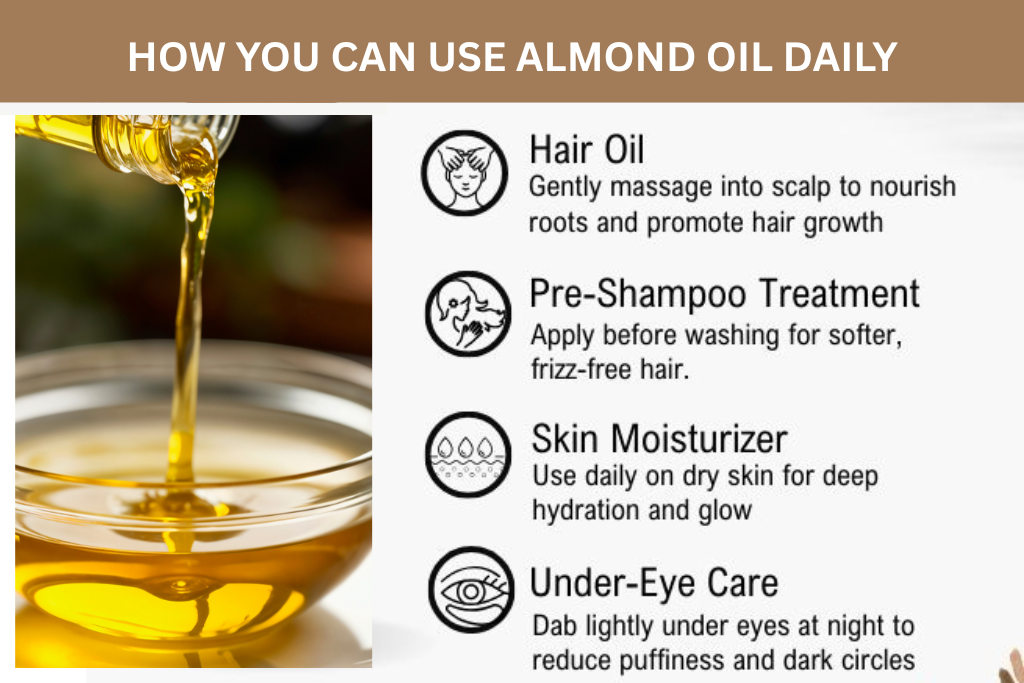
How You Can Use Almond Oil Daily
Some people make this complicated, but truly, almond oil is as straightforward as it comes.
- A few drops on the face at night:
Spread with slow, upward strokes. Let it settle. - Under the eyes:
One drop is enough for both sides. Tap gently. - After bathing:
The skin is slightly damp then, so the oil spreads well without feeling heavy. - For dry patches:
Especially useful in winters. A little goes a long way. - As a gentle makeup remover:
Massage lightly, wipe, then wash with a mild cleanser.
What matters is consistency, not quantity.
Choosing the Right Almond Oil: What to Look For
If you are trying to find the best almond oil in India for skin, there are a few practical things you can check:
- The oil should be wood-pressed or cold-pressed.
- It should not smell like perfume. Real almond oil has a soft, somewhat nutty aroma.
- Pure oil is slightly thick. If it feels watery, it has likely been processed heavily.
- Transparency from the brand always helps. A brand that shows how its oils are made usually has nothing to hide.
Matrika Natural Foods stands by these points because we built the brand around them—not the other way around.
A Closing Note on Simplicity and Tradition
If there is one thing almond oil teaches us, it is that skincare doesn’t have to be complicated. A single pure oil can often do the work of several products. But purity depends on the method, and the method depends on intention.
At Matrika Natural Foods, our intention has always been to honour the older ways—the ways that kept families healthy long before “skincare routines” became a phrase. From slow pressing to ethical sourcing, every choice we make is a return to that older wisdom.
Your skin doesn’t need ten products.
It needs one pure ingredient used consistently.
And purity, when respected, always returns the favour.
Frequently Asked Questions (FAQs)
Q1. Can I apply almond oil on my face every night?
Yes, if it is pure wood-pressed oil, nightly use is safe for most people.
Q2. Will almond oil reduce dark circles?
It can soften their appearance over time, especially with regular, gentle application.
Q3. Why avoid refined almond oil?
Refining uses heat and chemicals that weaken natural nutrients.
Q4. Does almond oil suit sensitive or dry skin?
Often yes, but it’s always wise to try a small patch test.
Q5. What makes Matrika Natural Foods almond oil special?
Traditional wooden Kolhu extraction, chemical-free processing, authentic texture, and a commitment to supporting Indian farmers.